
Aug 2026
Program Overview
Believe in What You Can Achieve
The Amber-Rose Berry Crossing
SHE DID IT! Amber-Rose Berry Becomes Youngest South African Woman to Swim the English Channel
Read About Her Epic Journey Here
The Girl Whose Dreams Were Too Big
Amber-Rose Berry was 16 when she told her new swim coach: 'I want to do the False Bay crossing.' And he gave a laugh.
It didn't matter that Cape Town’s False Bay crossing was an iconic open water swim of 33 kms (21 miles); the domain of a few top athletes prepared to battle the open sea from Miller's Point on the Cape Peninsula to Rooiels, a small coastal village at the foot of the Klein-Hangklip Mountain, just north of Pringle Bay.
Amber-Rose wanted it, and coach Clinton Le Sueur’s reaction didn't throw her, despite his reputation as a top long-distance and ice swimmer.
'I'd sort of come to expect it - that my dreams are just a bit too big for everyone else.'
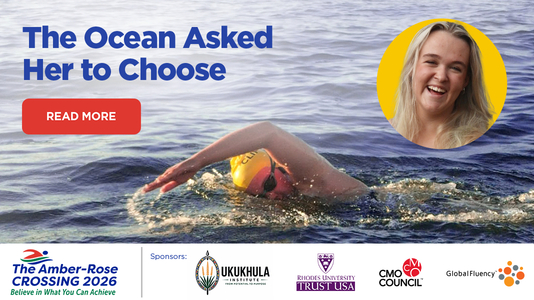
By the next day, though, his stance had changed and he was totally behind her. And in 2023, this young Pringle Bay woman became the youngest person ever to swim the 33km swim, recorded in the Guinness Book of Records. She made it, solo, without a wetsuit, in 9 hours 40 minutes.
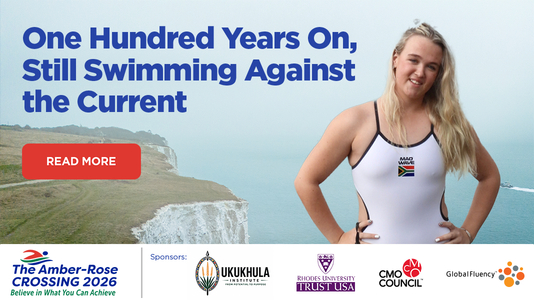
On Sunday, August 23rd, 2026, Amber-Rose became the youngest South African woman to swim the English Channel, the world's most iconic open-water swim. While the distance is almost the same as False Bay, this was by far the more challenging swim, mainly due to strong currents and shipping.
Amber-Rose represented South Africa in national Women's Month, celebrating the momentous women's march against the Pass Laws in 1956 – exactly 70 years ago. She's proud of that historic synchronicity. Her swim is dedicated to South African women: to all they have achieved and still can, and to her country as a whole.
Amber-Rose believes her struggles – against the elements and her inner self – serve to inspire other young people to set goals and fight for them. In that, she personifies the slogan, Believe in What You Can Achieve, adopted by the fundraising campaign set up in her name, and tied to her swim.
The campaign will continue to raise funds for the newly launched Ukukhula Institute in Makhanda. This advanced sports academy provides scholarships for disadvantaged student-athletes from Eastern Cape high schools to attend Rhodes University, the alma mater of her mother, Karen Berry.
background
'You can't just sit on the step forever'
Swimming did not come easily to Amber-Rose. She battled an early terror of water before becoming a name in open water swimming.
Growing up in Fish Hoek turned it all around – happy hours spent playing on the beach and in the sea with her mom and friends. 'Growing up there, even just playing in the sea, you sort of pick it up. The swimming comes naturally from playing with older kids …
'It's actually really beautiful. You can still stand in the ocean and have fun. And it's not like you have a choice to put your face in the water. In the ocean, you can't just sit on the step forever.'
It was as though the sea gave her courage. And very soon, she was brave enough to swim out past the big waves with the big kids.
As soon as she was old enough, she joined Nippers, and it just clicked for her. Even today, she loves surf lifesaving. 'I love sitting duty, I'm very involved with the club and the community. But more than anything, because I get to swim in the sea – how cool is that?'
The real turning came in grade 4, when she was called to the front office after the inter-house gala. Over the school intercom, they announced that she'd broken four school records. 'And I was like, oh, I'm not even really a swimmer, but thanks. Yeah, from there, it was my thing.'
'Wouldn't it be cool if the girl does it?'
Amber-Rose started open water swimming at 11 and, in the next couple of years, she raced 3 and 5km for the Western Cape team, right up to national level. Then, one day, the high school kids organised a relay swim to tackle False Bay and she – still in primary school – was asked to jump in.
She was always first in, last out of the water and her disappointment was extreme when the swim was called off for safety reasons. The dream had been born. 'I thought, you know what? Maybe I'll just do it by myself.'
She completed her first 7.5km Robben Island crossing at 13. She trained with her best friend's 16-year-old older brother. But 3km into the swim, he'd had enough.
'I looked up to him, and considered him a much better swimmer. And I thought, if he can't manage it, then how the hell am I going to be able to do it? Maybe he'll get too cold on the boat … am I being selfish staying in the water?
'But then I think that 13-year-old me just said: wouldn't it be cool if the boy doesn't finish and the girl does?'
Not only did she finish, but she's completed three Robben Island swims and represented South Africa in still water lifesaving events.
Late suppers in a box
Training for the False Bay swim meant sacrificing much of normal teenage life. She was in the pool for six to seven hours a day, starting a 4.30am, and again after classes till late in the evening.
Rhenish High School, where she boarded, was known for its swimming and expectations were high that she'd compete for the school team.
'I was so fit, but I was endurance fit. I wasn't sprinting fit. I didn't make the teams, or the touring team, and that was all really hard. All my friends in hostel were seeing me training so much, and I was so embarrassed.'
Clearly unmoved, the school coach told her: 'You got your priorities wrong. You chose to swim False Bay, so you can't be upset if you're not making teams.'
'It felt like no one understood.'
In the boarding house, she had to sign up for late supper, which would be waiting for her in a little box. She'd warm it up and eat it alone each night.
'I used to sign up with one of my friends' names as well, so that I'd get double the food. I'm lucky they never caught me out with that one. I would have been in a bit of trouble.'
'I'll see you on the other side'
She swam False Bay on 3 December 2023, when she was 16, with a 4.30am start.
'I remember standing at the slipway, in the pitch black, with just me and my mom – the boat waits for you out on the water. I couldn't see Hangklip, I couldn't see where I was swimming to. I had to stop and take off my goggles, because I'd actually filled up my goggles with tears.'
In that moment, she was overwhelmed. 'It's scary to stand in the pitch darkness all by yourself and look out at endless ocean, knowing you have to swim across that.'
Karen Berry watched her daughter almost give way to her nerves. Against her mother's instinct to gather her up, she said: 'I'll see you on the other side.' And with that, she left.
Karen is Amber-Rose's manager, or 'momager', as she refers to herself. She has to maintain that difficult balance between toughness and support.
Shortly after the False Bay swim, one of the top channel pilots, Stuart Gleeson, contacted them. 'Can she do it this August,' he said.
It was Karen who insisted she complete her last two years of school before even attempting the swim. And now it's upon them, in a matter of weeks. And, of course, Karen will be on the boat, watching over her daughter every stroke of the way. She has seen her daughter stand at the edge of impossible things before, and swim towards them. She knows what's coming.
'I'm her emotional support human,' she says. Where else would she be?
The coach who laughed has been her constant support since that day. So is everyone who ever underestimated how far a dream could take a girl from Pringle Bay. All that remains is the water.